“Are you playing with your little trains?”
“I don’t know how you see that, mate!”
Playing with ‘little trains’ is definitely a minority pursuit; even more so when the trains themselves are particularly little.
My passion for model-making is all about creating lost worlds, or beautiful places that you can immerse yourself in, with the texture and detail of life. For me, that means ‘finescale’ model making, but in the smallest scales that are feasible – the smaller each model, the more it can form part of a scene, rather than standing as a jewel on its own.
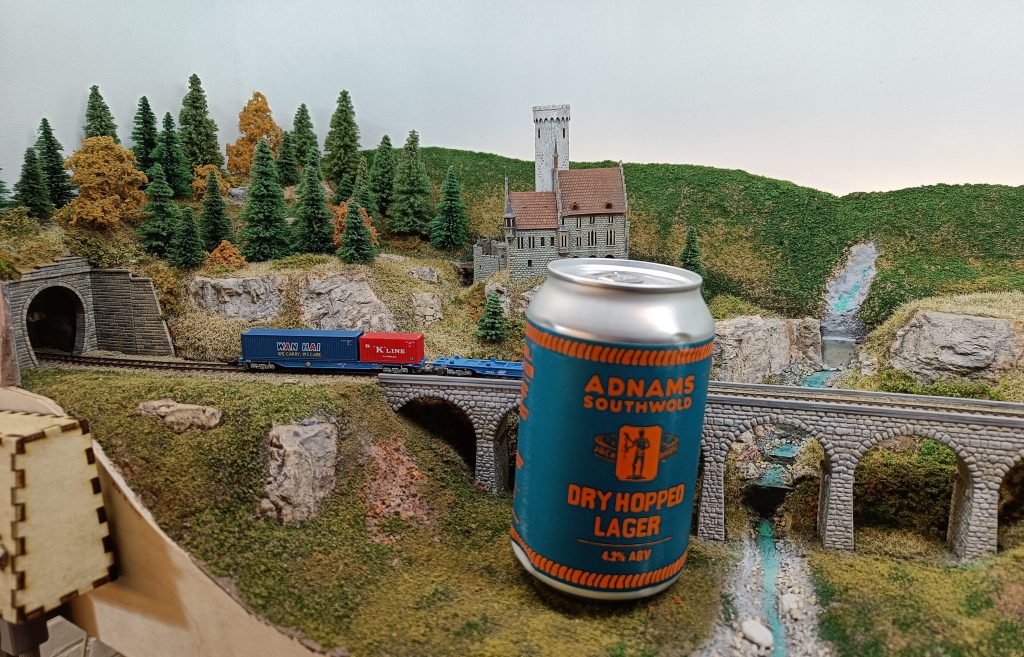
Wanting to see a model in, and as part of, a landscape is a big part of what drives me to model in the smallest feasible scale for any given thing. That might be a British steam locomotive in 2mm Finescale (1:152), a modern electric train in British N Gauge (1:148), or a Canadian, Swiss, or German train in Z Scale (1:220). The smaller the model, the more of it you can have within a believable scene in a reasonable space, whether that is a sprawling cityscape or a dramatic alpine landscape. Small things are also just intrinsically fascinating to me – I certainly identify with Japanese kawaii culture!
“All the right notes, not necessarily in the right order”
‘Finescale’ is sometimes dismissed as rivet-counting, but for me it is about a consistent approach to a plausible level of detail across all aspects of a model and layout. I want each model to have the depth of detail, tone, and ‘presence’ to feel like it really could be part of its landscape. That doesn’t necessarily mean it has to have every last detail absolutely correct, just that it has to be individually plausible, and more importantly to add to, rather than detract from, the whole. Sometimes that is more a question of what you deliberately leave out, as well as what detail you add. That is particularly true when it comes to a landscape as a whole – to look plausible in a reasonable space, it is often far more believable to compress and manipulate the ‘real world’ to create a scene that tells a story.
Storytelling is an aspect of model-making that is only really starting to be discussed (not least by James Hilton). For some, this can mean inventing characters and scenarios to animate the models they build. For others it is about recreating a particular moment from history or memory. For me, a lot of my motivation is about creating an immersive window into a lost world – either a world lost to to time, or a place that has inspired me but that is out of reach. Modelling subjects and eras that are common tend to leave me cold: for me, 1950s and 60s black BR steam locomotives and green diesels are so familiar that there is no sense of novelty or discovery in modelling them. While I’m far from immune to nostalgia, it is the unusual and the forgotten that tend to motivate me: the pre-grouping era of British railways that was so characterful and vivid, but is now entirely out of living memory; tucked-away corners and tumbling down buildings, and now-esoteric seeming industries of the past and the forgotten lives that they shaped.
I’m also a butterfly: my mind wanders and flits between passionate focus on different projects over time. Finding a historical image or example that captures my interest; seeing particularly evocative view; or discovering a technology, method, or product, often inspire me to imagine a new project to put the vision or possibility I’ve imagined into practice. This is how I have ended up with projects ranging from the pre-World War One rural landscape of East Anglia in 2mm Finescale, to the German Black Forest in Z Scale, and the odd World War Two aeroplane in 1:144 scale. Some of these projects absorb my mind for a few days but get no further, some lead to me to buy models and materials which I end up putting aside ‘for another day’ quite quickly, others might come together quite solidly. But very few are ever ‘finished’ – and I’m fine with that – the journey is often more fun than the destination.

 LittleTrains.blog
Leave a comment